Agentic AI is not a smarter chat. It is a coworker with hands.
A chat model talks. An agent works. The difference is not a better prompt - it is a model that knows when to reach for a tool, picks the right one, runs it, and checks itself. That is the entire jump from "demo" to "this thing actually moved a number."
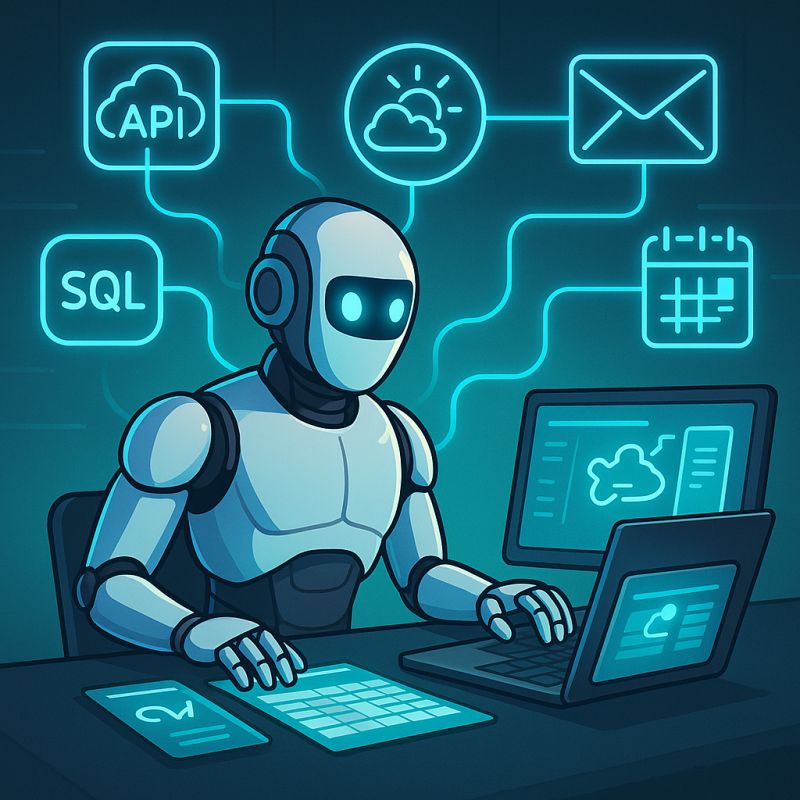
A short answer first. Most people picture AI as a smart chat. You ask, it answers. That is true, but only up to a point. The thing you talk to in ChatGPT is an LLM - a large language model. It writes, explains, summarizes, and connects ideas, but only inside its own head. No eyes. No hands. No access to your world. An agent is the same model with tools attached, plus the judgment to decide when to use them, which one to pick, and whether to try again. That second part is the entire jump from "neat demo" to "this is doing real work."
If you only remember one line: an LLM talks, an agent works.
LLM vs. agent, in plain language
An LLM is a brain in a jar. Brilliant inside the jar. Useless outside it. Ask it for the weather in Tel Aviv right now and the honest version of itself shrugs - it has no internet, no clock, no sensor. Whatever it tells you is either a guess or a refusal.
An agent is the same model with a small but critical upgrade: it can call tools. A search tool. A database. An API. A calendar. A code interpreter. And it has the judgment to know that "what is the weather in Tel Aviv" is not a writing task, it is a lookup task - so it does not invent an answer, it goes and gets one.
That is the whole shift. Four moves an agent does that a chat model does not:
- →Recognize that a task needs a tool. Not every question is a writing question. The agent learns to spot the ones that need the outside world.
- →Pick the right tool. A search engine for fresh information. A SQL query for internal data. A code runner for math. The agent chooses.
- →Run the tool and read the result. Then it folds the result back into the conversation, summarized in your language, not raw JSON.
- →Check itself and retry. If the result looks wrong, the agent can re-run, try a different tool, or escalate. A chat model just keeps writing.
That is the difference between someone who talks and someone who works.
A simple example
You ask ChatGPT: "Check the weather in Tel Aviv right now."
The chat-only version either guesses ("it is usually warm this time of year") or refuses ("I cannot access real-time information"). Neither is what you wanted.
The agent version recognizes the request needs an action. It picks a web search tool, runs the query, reads the top results, and writes a one-sentence answer with the current temperature and conditions. From your side it looks like one clean response. Under the hood it is: recognize → pick tool → call → read → summarize.
The tool is not the model's imagination. It is a real connection to the world. The moment the model uses that connection itself, without you holding its hand, it has crossed from chat to agent.
Now give the agent more tools
Weather is the toy example. The real story starts when you wire the agent into the systems your team already uses every day.
Once an agent has open access to tools like these, it stops being an assistant. It becomes a worker. Or a project manager. Or a researcher. Or a support agent. Or whichever role you scope it to.
That is what "agentic AI" actually means, stripped of the marketing layer. Not "the AI is now sentient." Just: the model is now allowed to act, through tools, on the real systems your business runs on.
Why this matters for B2B teams
If you are buying or building AI for your company, the LLM-vs-agent distinction is not academic. It changes what you can deploy.
- →A chat model gets you a smarter search box. Useful. Real value. But the human still has to take the answer and go do something with it.
- →An agent gets you a teammate. It does the thing. It updates the record, sends the email, files the ticket, runs the report. The human reviews and approves, instead of typing.
- →The bottleneck moves from "is the model smart enough" to "is the agent allowed to do anything." Permissions, auditability, and a named human owner become more important than the model choice.
Most "AI strategy" decks we read in mid-2026 are still planning chat-model deployments. The teams that win the next 18 months are the ones already designing agent roles - with scoped permissions, written job descriptions, and a clear escalation path when the agent is unsure.
Your turn: pick a task
Here is the exercise. Think of one real task on your plate this week. Something that eats your time, is boring, repeats, or just annoys you.
- →The weekly status email you write from three dashboards.
- →The first-pass review on inbound CVs.
- →The "find me the contract section that says X" hunt across the shared drive.
- →The Monday morning report that pulls the same numbers from the same systems.
- →The triage of yesterday's support tickets into "urgent / not urgent / needs engineering."
Now ask: could an agent do this if it had the right tools? Read your inbox, query your database, open your spreadsheet, write the draft, hand it to you to approve?
Most of the time, the answer is yes. The work to actually ship that is mostly not in the model - it is in the tools, the permissions, and the org muscle to trust the output. That is the real game.
If you have a task in mind and want to know whether an agent can do it for you, that is most of what we do at Bina Labs. Bring the task. We will tell you honestly whether it is ready.
FAQ
Written by Michael Fleicher, Principal at Bina Labs. Two-time CTO. We embed senior AI engineers into B2B teams that are done with chat demos and want agents that actually do the job. If you have a real task in mind and want to know whether an agent can run it, start here.