Salesforce promised 1 billion AI agents. They sold 3,000. The 99.9% gap is not a tech problem.
Marc Benioff promised one billion AI agents by 2025. Salesforce shipped roughly 3,000. The technology works. What failed is the assumption that you can install a digital coworker the way you install a printer.
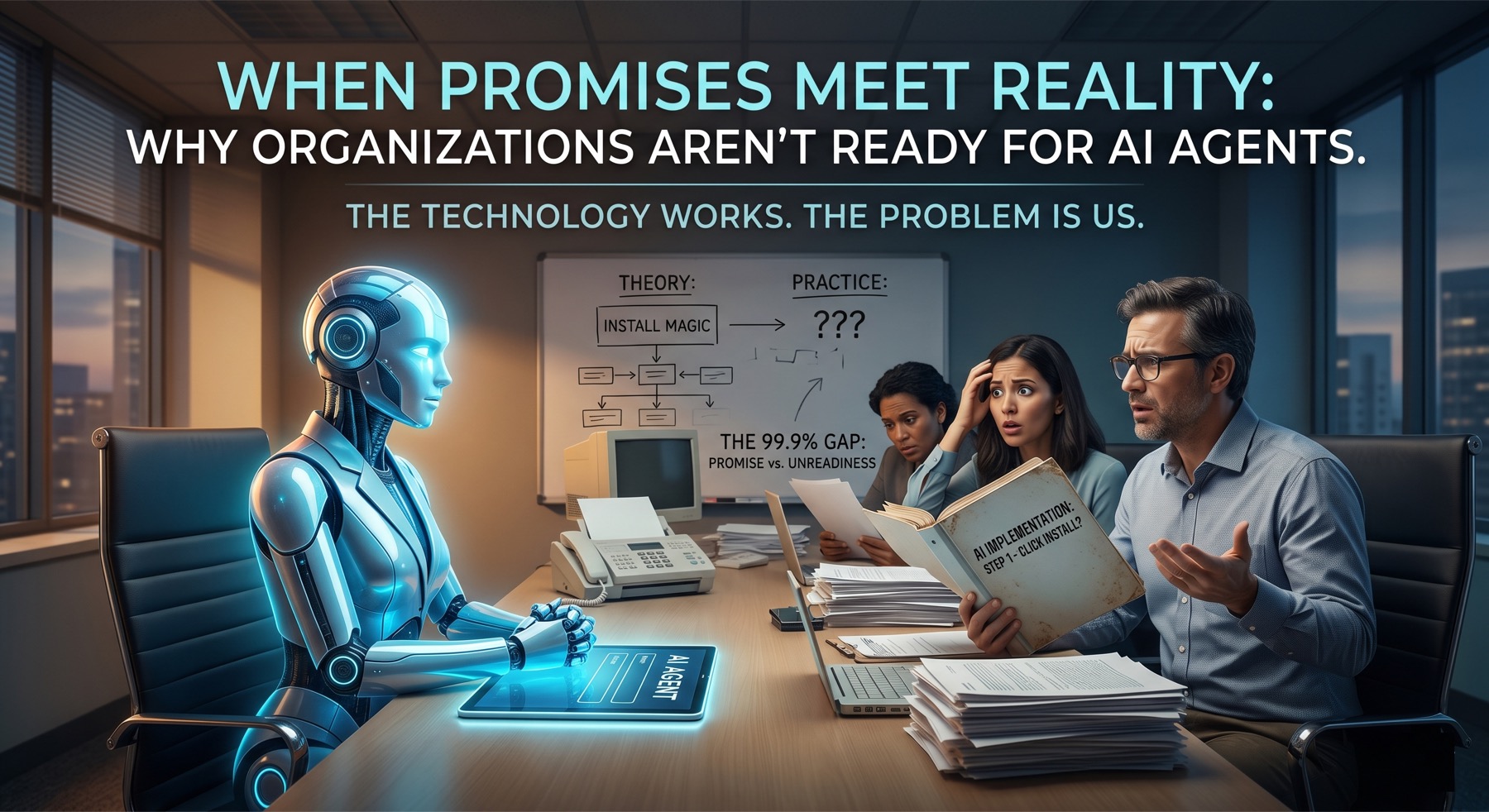
A short answer first. Marc Benioff publicly committed Salesforce to "one billion AI agents in production by the end of 2025." The actual number is on the order of three thousand. That is a 99.9% gap between the promise and the delivery, and the temptation is to blame the model. Don't. We deploy these agents every week across high-tech, finance, real estate, law, retail, and the defense industry. The model is fine. What breaks, every single time, is the organization. AI agents are not software you install. They are digital coworkers you have to onboard, and most companies have no idea how to onboard a coworker who is right 90% of the time, never sleeps, and has never been to HR.
The gap is not a Salesforce gap. It is an industry gap. Benioff is just the loudest CEO who set the goalposts in public.
What actually happened
The Agentforce launch was supposed to be the moment "agentic AI" crossed from demo to revenue. Salesforce poured product, marketing, and a Dreamforce keynote into the number. The number did not happen. Internal teams rotated, the language softened from "billion" to "millions of agentic interactions," and the field reps started selling Data Cloud seats again because at least those close.
Two things are true at the same time:
- 01The capability shipped. Agentforce 360 (the platform's current generation) can call tools, route conversations, escalate, and write back to the CRM. It is not a toy. A version of it works in production, today, for customers who put in the work.
- 02The deployments did not. Most pilots stalled at the boundary between "the demo runs" and "the agent is allowed to actually do anything in our system without a human re-typing it."
That second sentence is the entire 99.9%.
What an AI agent actually is
Most managers are still thinking about agents in last-decade categories. They think an AI agent is a smarter chatbot, or a macro, or a particularly clever Zapier flow. They click "Install," they assign it to a queue, they expect magic.
It is the most expensive misunderstanding in enterprise software right now.
An AI agent is a digital worker. Not a metaphor. A literal coworker that:
- →Has a job description (or doesn't, and then it does whatever the prompt felt like).
- →Has permissions to systems (or doesn't, and then it can't do the job).
- →Has a manager, an escalation path, and a definition of "done."
- →Has working hours, an SLA, a quality bar, and an audit trail.
- →Has peers, a handoff protocol, and a story for when it gets it wrong.
If you would not hire a human into a role without those seven things, you cannot deploy an agent into that role either. Companies that figure this out get production agents. Companies that don't get a Slack channel full of "the AI keeps doing weird things."
What we see on the ground
We have shipped agents into companies across the spectrum. The technical work is the easy part now. The organizational work is the entire job. A pattern repeats:
The cracks are not in the code. They are in the seam between the agent and the organization.
The winning formula
The deployments that work, in our experience, combine two things that almost never live in the same room:
1. Advanced technical capability - the agent's brain.
Tool use that actually works. Retrieval that returns the right document, not a vector-similar one. Evals with a held-out set, a rubric, and an honest disagreement number between human raters. Guardrails that fail closed, not open. Observability so you can see what the agent did and why. This is the part everyone thinks they are buying.
2. Cultural preparation of the organization - the muscle that activates the brain.
A named human owner for the agent. A role description. A permission scope. A 30/60/90 review cadence. A re-training loop when policy changes. A defined "the agent should escalate to a human when..." rule, written down. A KPI the agent moves, with a baseline measured before launch. A communication plan for the team whose work changes. This is the part nobody thinks they need to buy, and it is the part the deployment actually fails on.
If the organization is not willing to change the way it works, no smart agent will save it. We have refunded engagements that crossed this line. It is cheaper for everyone.
When the organization mobilizes, the same agent - same model, same prompt, same tools - goes from "weird Slack channel" to "this team's senior member" in about eight weeks. The results look like magic. They are not magic. They are change management dressed in a model card.
What this means if you are buying agents
Three filters Salesforce did not put on the front of the funnel, but you should:
1. Name the human owner before you sign.
Every agent in production needs one named human accountable for its work. Not a committee. Not "the AI CoE." A person whose KPI moves when the agent succeeds and whose calendar gets blocked when it fails. If you cannot name that person at signing, you are not ready to deploy. You are ready to do a slide.
2. Write the job description before you write the prompt.
A one-page document, in your business's language, describing: what the agent is responsible for, what it is explicitly not responsible for, what systems it can read, what systems it can write to, what triggers an escalation, and how its output is measured. If you cannot write this page, the prompt will not save you. The prompt is the implementation of this page.
3. Demand a four-week pilot with a real KPI, not a demo.
A working agent in your environment in four weeks, hitting one measurable business metric on a real workload, costs less than the multi-quarter rollout you are about to plan. If your vendor cannot or will not commit to that, they are selling Dreamforce, not Agentforce.
What this means if you are building agents
Three things the industry got wrong in the "billion agents" era and will get wrong again:
- 01Stop shipping agents. Start shipping roles. An agent without a defined role is a chatbot with extra steps. A role without an agent is just a job. The product is the role plus the agent plus the org change. Sell the whole bundle or none of it.
- 02Evals are not optional and they are not the deck. If you cannot tell a buyer, in week one, how you will measure the agent, with a rubric and a held-out set and a number for inter-rater disagreement, you are not building an agent. You are building a demo. The 99.9% gap lives in the difference.
- 03Org-readiness is a deliverable, not a prerequisite. The "the customer wasn't ready" excuse is the consultant's version of "the dog ate my homework." If your engagement does not include the change management, the role design, the permission scoping, and the manager training, your agent will join the 999,997,000 that did not ship. Make readiness part of the contract, or pick easier customers.
The honest take
Salesforce did not fail at AI agents because the AI agents do not work. Salesforce failed at AI agents the way every enterprise software company in the last forty years has failed at any tool that requires the buyer to actually change how their team operates: by selling the tool and assuming the change will happen on its own.
The 99.9% gap is the gap between a button that says "Deploy Agent" and a Tuesday morning where Sharon from claims processing has to admit that part of her job is now being done by something she did not interview, did not hire, and does not know how to fire. That gap is human. It is cultural. It is messy. It is not solvable by a better model.
The companies that will run real fleets of agents in 2027 are the ones that started running real fleets of one in 2026. They are not waiting for the technology. The technology is already past them. They are waiting for their organizations to catch up - and the organizations only catch up when someone makes them.
If you are deploying agents: stop installing, start hiring.
If you are buying agents: name the owner, write the job, demand the pilot.
If you are Salesforce: the next billion is not a marketing problem. It is an onboarding problem. Onboard accordingly.
FAQ
Written by Michael Fleicher, Principal at Bina Labs. Two-time CTO. We embed senior AI engineers and change-management leads into enterprise teams that are done with agent demos and want agents that actually run a job. If you want to talk about a real deployment - including the org work, not just the model - start here.